BMI for Children and Teens: How It's Calculated and Interpreted Differently
Child and teen BMI uses age- and sex-specific percentiles, not the adult 18.5–24.9 range. Here's what parents need to know about the CDC's pediatric BMI system.
- bmi
- children
- teens
- pediatric bmi
- healthy weight kids

Medical Disclaimer: This article is for informational purposes only and does not constitute medical advice. If you are concerned about your child’s weight or growth, consult a pediatrician. Do not put a child on a weight-loss diet without professional guidance.
BMI works differently for children and teenagers than it does for adults. The formula is the same — weight divided by height squared — but the interpretation is entirely different. For children aged 2–19, BMI is not evaluated against fixed category thresholds. Instead, it is compared against a reference population of same-age, same-sex peers and expressed as a percentile. This matters, and getting it wrong can cause unnecessary anxiety or miss real concerns.
Why BMI Is Interpreted Differently for Children
Children’s bodies change dramatically during growth. A BMI that is entirely appropriate for a 6-year-old girl is different from an appropriate BMI for a 15-year-old girl or a 6-year-old boy. Body fatness naturally fluctuates during childhood: it is typically higher in infancy, lower during the “adiposity rebound” period around ages 5–6, and then rises again through adolescence.
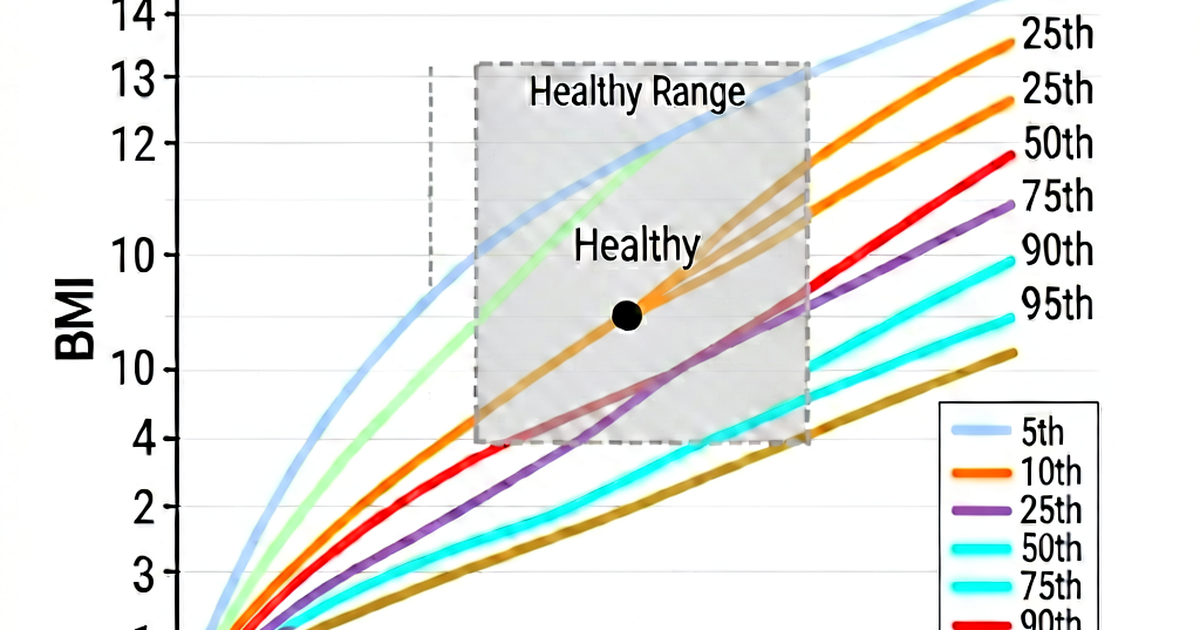
The CDC addressed this by developing growth charts — based on nationally representative data — that show how a child’s BMI compares to other children of the same age and sex. The result is a percentile: a child at the 60th percentile has a BMI higher than 60% of same-age, same-sex peers. (CDC — BMI for Children and Teens)
The Four Pediatric BMI Categories
The CDC defines four weight categories for children and teens based on BMI-for-age percentile:
| Percentile | Weight Category |
|---|---|
| Below the 5th percentile | Underweight |
| 5th to less than 85th percentile | Healthy weight |
| 85th to less than 95th percentile | Overweight |
| 95th percentile or above | Obese |
Source: CDC — Defining Childhood Obesity
Note what these categories do not include: a fixed BMI number like 25 or 30. A 10-year-old at the 95th percentile may have a BMI of 22, while an adult with the same BMI 22 is in the “normal” range. The absolute number is much less meaningful than the percentile position.
Why Both Age and Sex Matter
Age: A BMI of 17 in a 5-year-old likely reflects healthy growth. The same BMI in a 17-year-old would warrant attention. The percentile framework captures this automatically.
Sex: Boys and girls develop at different rates and accumulate body fat differently during puberty. Girls typically experience earlier adiposity rebound and a larger increase in body fat during adolescence; boys develop more lean muscle mass. Applying a single unisex curve would systematically misclassify many healthy children. The CDC uses sex-specific charts to account for this.
Practical Example: Interpreting a Child’s BMI
Child: 12-year-old girl, 5’1” (61 inches), 110 lbs.
- Calculate BMI: (110 × 703) ÷ (61 × 61) = 77,330 ÷ 3,721 = 20.8
- Look up percentile on the CDC BMI-for-age chart for girls aged 12. A BMI of approximately 20.8 at age 12 falls around the 75th–80th percentile.
- The 75th–80th percentile is within the Healthy weight range (5th to 85th percentile).
Interpretation: This child’s BMI is healthy. The 80th percentile does not mean 80% body fat — it means the child is heavier than 80% of other 12-year-old girls in the reference population, but still within the normal range.
The CDC’s child BMI calculator plots the percentile automatically once you enter age, sex, height, and weight.
What to Do if Your Child Is Outside the Healthy Range
If your child is classified as overweight or obese:
- Consult the pediatrician first. A single BMI measurement is not a diagnosis. Growth trajectory, family history, and clinical context all matter.
- Focus on habits, not the number. The goal for most children is not weight loss but slowing weight gain while the child grows taller — gradually improving BMI without restricting calories in a way that affects development.
- Avoid singling out the child. Whole-family changes to diet and physical activity are more effective and less psychologically damaging than singling out one child.
- Be aware of eating disorder risk. Excessive focus on weight in children, particularly pre-teen girls, can increase risk of disordered eating. A pediatric dietitian or mental health professional can help navigate this.
If your child is classified as underweight:
- Underweight in children (below the 5th percentile) has multiple possible causes, including inadequate caloric intake, illness, or a growth disorder. A pediatrician should evaluate the cause before any intervention.
The Limitations of Pediatric BMI
Everything that limits adult BMI also limits pediatric BMI — inability to distinguish fat from muscle, inability to capture fat distribution — plus one more: BMI does not evaluate growth velocity. A child who was at the 50th percentile last year and is now at the 75th percentile (weight gaining faster than height) may warrant more attention than a child who has consistently been at the 85th percentile. Pediatricians track growth charts over time, not just at a single visit.
The CDC growth charts are also based on U.S. population data from the 1960s–1990s and may not perfectly represent today’s more diverse population. The WHO has separate growth standards for children 0–5, and some clinicians use those for younger children.
Key Takeaways for Parents
- Do not apply adult BMI ranges to children. The 18.5–24.9 “normal” range is only for adults 20 and older.
- Use the CDC’s online tool or ask your pediatrician for your child’s BMI percentile at the next well-child visit.
- The percentile range matters, not the absolute number. Healthy is anything from the 5th to just below the 85th percentile.
- Track trends. A single measurement is less meaningful than a pattern on a growth chart over several years.
- Talk to a pediatrician before acting. BMI is a screening signal, not a prescription.

Related reading
-
BMI Chart for Women: Understanding Your Results by Age and Height
A practical BMI reference chart for women, with height-by-weight tables, age-related context, and guidance on what the numbers mean for your health.
-
High BMI Health Risks: What the Research Says
A BMI of 30 or above is linked to higher rates of heart disease, diabetes, sleep apnea, and certain cancers. This article reviews what the evidence shows and what it doesn't.
-
How Is BMI Calculated? The Formula, Step-by-Step Examples, and Limits
BMI uses a simple formula—weight divided by height squared. This article walks through both metric and imperial calculations and explains what the result means.